The Neurodiversity Motion at General Synod & the Social Murder Festival at Manchester Metropolitan University
Two groups I’m part of have been doing important, impactful work through activism and research, this week.
- ‘All Kinds of Minds‘ – the General Synod motion on neurodiversity
- The first Social Murder Festival at Manchester Metropolitan University
‘All Kinds of Minds’ Motion
At 4.10pm today, the General Synod of the Church of England will be debating a motion on neurodiversity, barriers for neurodivergent people, and enabling our flourishing in the Church. I’m part of the Neurodiversity Working Group of the Church of England (NDWG), which has put this motion together. I’ve also been part of their research team (with Dr Krysia Waldock and Dr Brian Irvine) — we’ve been working on research with neurodivergent clergy about the barriers they face and how the church can enable their flourishing. Chair Fiona MacMillan writes about the motion here.
It’s a strange experience, when work you’re involved with ‘hits the headlines.’ The motion and research have shown up in the Times, the Sunday Times, the BBC and the Christian press, over the past week or so — some positive articles, some a little less so, but all engaging with the question of whether neurodivergent people belong in churches. It’s good to see that discussion moving out of the margins and into the mainstream of church, in recent years. Watching Synod debates in the background today, I’m hearing disability liberation theology — which is led by the voices of disabled people — in general discussion. That’s new and exciting. In my world, a lot of what researchers do is about shining a light on dark places, collating and archiving the evidence that activists need in their fight for change. It’s good to see that light shining in ever more corners of the Church of England.
My impulse as a researcher is to tell other people’s stories while hiding in corners from questions, so PR is not my forte! But it’s been fantastic to see the impact that this motion and research are already having, even before the debate. One fab response to the publicity comes from NDWG member Canon Dr Phil Groves, who writes a Christian response on the importance of kindness in a world that, sadly, is often far from kind. I hope the Synod neurodiversity motion shines a light on dark places in the church where we need much more kindness, and leads to change, for the church’s many neurodivergent members and leaders. After all, it’s a church that, while it can be ableist, is built on the hope of justice, diversity and love.
Social Murder Festival
The Social Murder Festival at Manchester Metropolitan University this week was another reminder that the world is far from kind to everyone, particularly the most marginalised minorities. Professor Sara Ryan uses the theory of social murder to shine light on the deep darkness faced by learning disabled people in our society, who die significantly younger than non-disabled peers.1 When society knows a marginalised group of people are suffering and dying through inequality and oppression, and does nothing, that’s social murder. That’s what so many activists, self-advocates, journalists and researchers came together to challenge and protest this week, hosted by the Learning Disabilities and Autism Research Group (the research team I’m proud to be part of). As researchers, we’re not innocent of this injustice, as much as we might want to help change it. The festival called a “collective” of powerful professionals to account for their (our) complicity in social murder. Just using this terminology can lead to huge pushback from people who think that term is a bit much, as Sara and other scholar-activists told us. But language that refuses to flinch away from the truth is one way to shine a light on the darkness. Social murder is a powerful framework to gather around to fight for change. We heard from many activists, self-advocacy groups, journalists, disabled people and bereaved family members who are doing just that, in their support for each other in the community, and in their truth-telling.
Of all the powerful moments at the festival, one will stick with me. Here’s Dr George Julian (open justice journalist and researcher who blogs about inquests after deaths of learning disabled and autistic people). George is holding up a timeline of fifty years of questions and debate in Parliament about the social conditions and deaths of people with learning disabilities, which has changed nothing. This timeline was taken to the House of Lords on Wednesday — presented as evidence for lobbying, calling Parliament to move from endless talking to doing something about the premature and preventable deaths of learning disabled people.
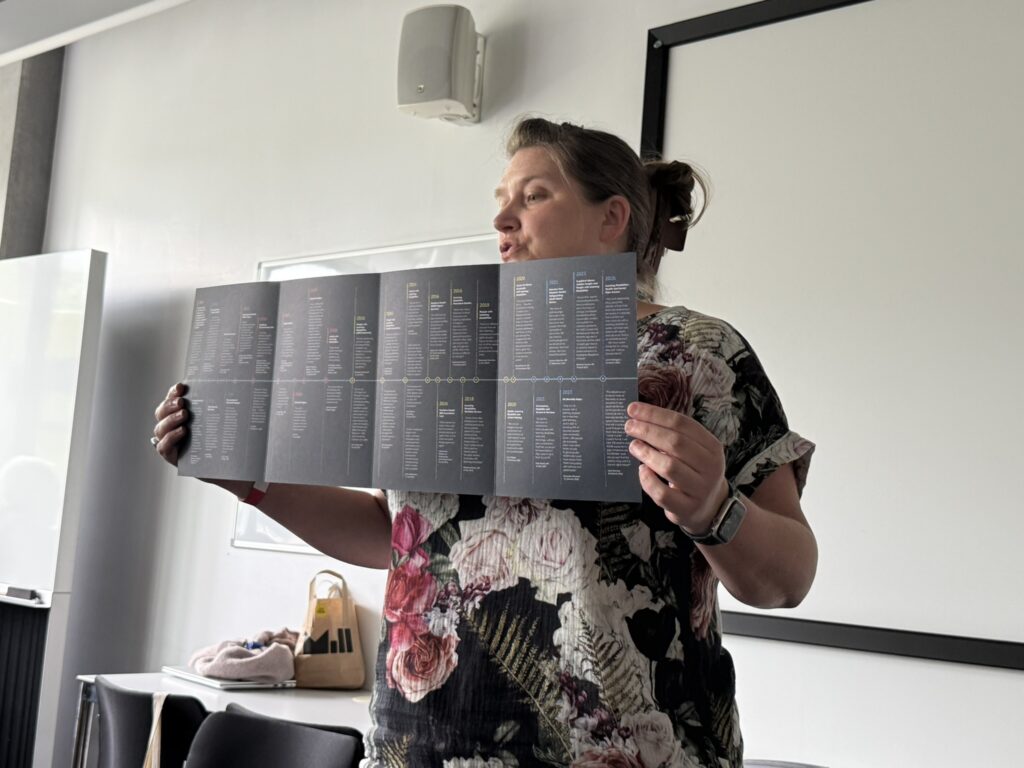
Yesterday, Lucy Easthope spoke at the festival about the power of collective action in the face of oppressive systems. She reminded us of the need for “constant vigilance,” in a society where eugenics has never gone away and where injustice for disabled people is deepening. For activists, that kind of vigilance is sometimes hard to balance with hope. But I believe shining a light on dark places and deep injustices is why social researchers are here. What we do, once that light has been shone — sometimes for 50 years, with no change for learning disabled people — is up to all of us.
The Social Murder Festival was dedicated to Connor Sparrowhawk.
- White learning disabled people die at an average age of 62; learning disabled people from minority ethnic communities die at an average age of 34. For non-disabled people, the average age of death is 81. ↩︎
Recent Comments